Choosing the right high school curriculum is an important decision for students planning to attend universities in Canada, the UK, the US, Australia, or other countries.
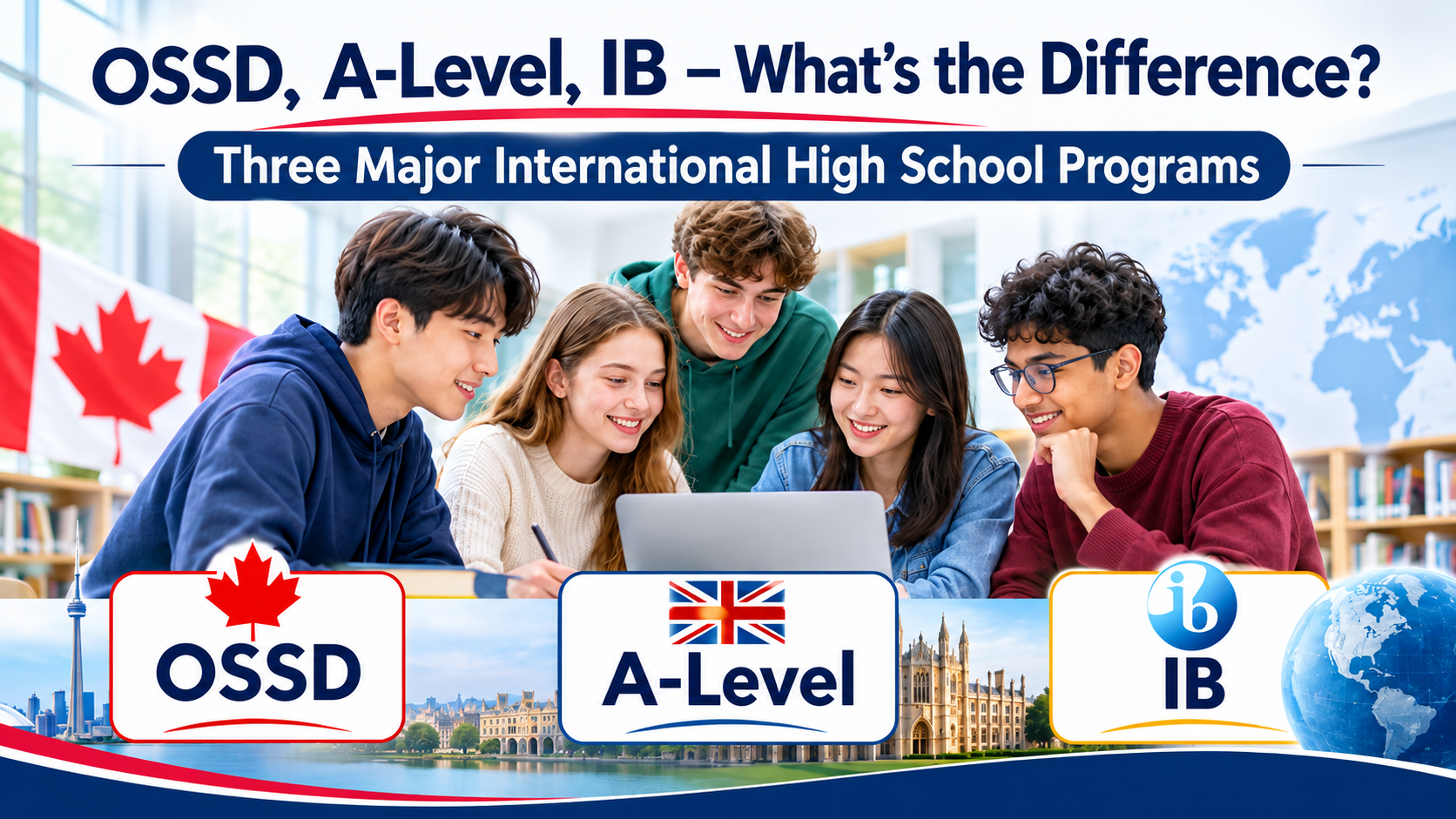
Three popular international education pathways are:
- OSSD – Ontario Secondary School Diploma (Canada)
- A-Level – Advanced Level (United Kingdom)
- IB – International Baccalaureate Diploma Programme (International)
Although all three qualifications are recognized by universities worldwide, they differ significantly in their learning structure, assessment methods, academic flexibility, and university preparation.
1. Quick comparison: OSSD vs A-Level vs IB
| Comparison | OSSD (Canada) | A-Level (UK) | IB Diploma (International) |
|---|---|---|---|
| Education system | Ontario, Canada | British | International |
| Typical duration | 4 years (Grades 9–12); varies with transfer credits | 2 years | 2 years |
| Subject selection | Broad selection of courses | Usually 3–4 specialized subjects | 6 subjects across different disciplines |
| Learning approach | Continuous learning and assessment | Subject specialization and in-depth study | Broad, interdisciplinary learning |
| Assessment | Coursework, assignments, tests and exams | Mainly formal subject examinations, depending on syllabus | Examinations and internal assessments |
| Flexibility | High | Moderate | More structured |
| Academic specialization | Gradual specialization | Strong specialization | Balanced breadth and depth |
| Research requirement | Depends on courses | Depends on subjects | Mandatory Extended Essay |
| Community involvement | 40 volunteer hours for OSSD | Not a general diploma requirement | CAS is compulsory for the full IB Diploma |
| Best suited for | Students seeking flexibility and a Canadian pathway | Students with clear academic strengths | Students who enjoy academic challenges across multiple disciplines |
Note: OSSD graduation requirements depend on the student’s Grade 9 entry year. The IB comparison refers to the full Diploma Programme, not individual IB courses.
2. Understanding the three education systems
A. OSSD – Ontario Secondary School Diploma
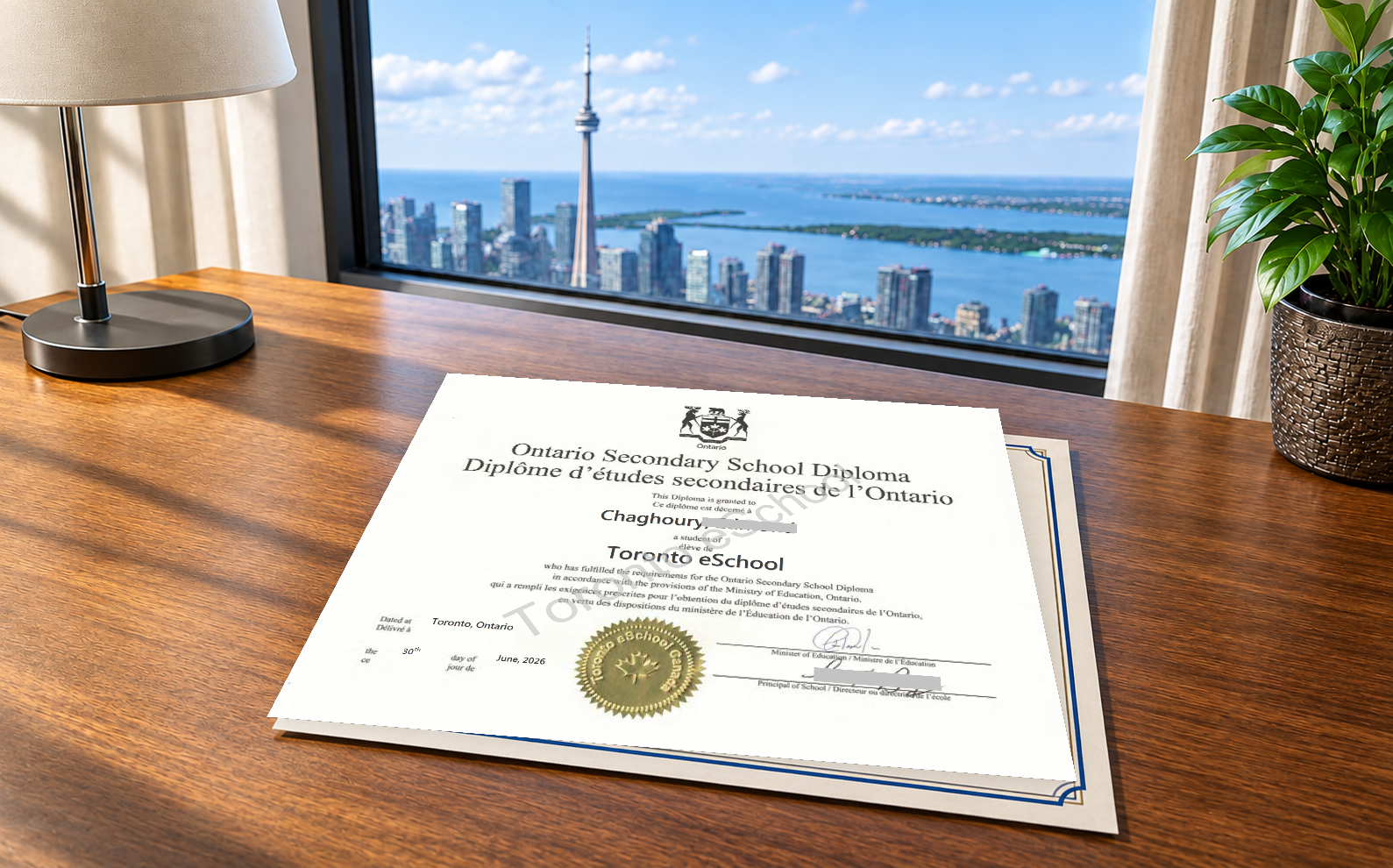
Ontario Secondary School Diploma (OSSD)
Canada’s Ontario high school diploma, awarded by authorized Ontario secondary schools.
The OSSD emphasizes continuous learning, academic development and flexibility.
Key features:
- Students earn credits by successfully completing individual courses.
- A wide range of academic and elective subjects is available.
- Assessment generally combines assignments, projects, tests and final evaluations.
- Students can select courses according to their university goals.
- Eligible students may transfer previously completed secondary school credits.
For students entering Grade 9 in 2024 or later, the standard requirements include 30 credits, the literacy requirement, 40 community involvement hours, two online learning credits and the applicable financial literacy requirement.
Advantages:
- Greater flexibility in course selection and learning pace.
- Suitable for students transferring from different education systems.
- A natural pathway for students targeting Canadian universities.
- Online learning options allow students to study from different countries.
B. A-Level – British Advanced Level
A subject-focused qualification widely used in the UK and internationally.
A-Level allows students to concentrate on a relatively small number of subjects, typically three or four.
Key features:
- Usually completed over two years.
- Students focus on subjects related to their intended university degrees.
- Strong emphasis on subject knowledge and academic depth.
- Assessment is primarily examination-based, although assessment methods vary by subject.
- AS Level may be taken as a separate qualification or as part of a staged A-Level pathway.
Advantages:
- Excellent for students with clear academic interests.
- Allows deeper study of selected subjects.
- Particularly suitable for students targeting UK universities.
- Recognized by universities internationally.
C. IB – International Baccalaureate Diploma Programme
An academically comprehensive programme designed to develop well-rounded students.
The IB Diploma Programme combines academic study across multiple disciplines with independent research and extracurricular development.
Key features:
- Six academic subject groups.
- Three to four subjects at Higher Level (HL), with the remainder at Standard Level (SL).
- Theory of Knowledge (TOK).
- Extended Essay (EE).
- Creativity, Activity, Service (CAS).
- A combination of final examinations and internal assessments.
Advantages:
- Develops critical thinking and independent research skills.
- Encourages a broad academic foundation.
- Provides opportunities to explore different disciplines.
- Well suited to students who enjoy a challenging, comprehensive curriculum.
3. Which curriculum is more suitable for university admission?
All three qualifications can provide pathways to internationally recognized universities. However, the best option depends on the student’s academic strengths, intended university destination and preferred learning style.
| University destination | Suitable pathway |
|---|---|
| Canada | OSSD, A-Level or IB |
| United Kingdom | A-Level, IB or OSSD |
| United States | OSSD, A-Level or IB |
| Australia | OSSD, A-Level or IB |
| Europe | All three, subject to university requirements |
An important consideration: Universities do not simply prefer one curriculum over another in every situation. They assess academic performance, required prerequisite subjects, qualification equivalencies and other admission criteria.
For example:
- A student applying for Engineering should have the appropriate advanced mathematics and science preparation.
- A student applying for Business should consider mathematics and relevant academic prerequisites.
- A student applying for Medicine should carefully check specific subject requirements, particularly Biology and Chemistry.
4. Why are more international students considering OSSD?

OSSD has several features that make it attractive to international students:
1. Flexible learning arrangements
Students can complete courses through in-person or online learning, depending on the school and programme.
2. Credit transfer opportunities
Students who have studied in other countries may receive transfer credits after an official assessment of their previous academic records.
3. Continuous assessment
Instead of relying primarily on a small number of final examinations, OSSD courses generally evaluate students throughout the learning process.
4. Canadian university pathway
OSSD is an Ontario high school diploma, making it a direct pathway to Canadian university applications, subject to each university’s admission requirements.
5. Study from anywhere
Students enrolled in an appropriately authorized online Ontario school can complete their courses while living outside Canada, without necessarily relocating to Ontario.
5. Which curriculum should students choose?
Choose OSSD if:
- You prefer flexible learning arrangements.
- You plan to apply to Canadian universities.
- You want to transfer credits from another education system.
- You prefer continuous assessment over a predominantly examination-based system.
Choose A-Level if:
- You have strong academic interests in specific subjects.
- You prefer focused and in-depth subject study.
- You are particularly interested in applying to UK universities.
Choose IB if:
- You enjoy studying a wide range of subjects.
- You are comfortable managing a demanding workload.
- You enjoy research, critical thinking and independent learning.
6. Final thoughts: Is OSSD a good choice?
There is no universally best high school curriculum. OSSD, A-Level and IB each offer different advantages.
However, for international students seeking a flexible Canadian high school education and a pathway to universities worldwide, OSSD is certainly worth considering.
Its credit-based system, flexible course selection, continuous assessment and online learning opportunities make it an attractive alternative to traditional high school programmes.
7. Can Students Switch from O-Level, A-Level or IB to OSSD in Grade 12?
Yes. Switching to the OSSD programme in Grade 12 can be a good option for students who have previously studied under the British (O-Level/A-Level) or IB education systems.
Some students find A-Level or IB academically demanding and may struggle to achieve the grades they need for university admission. In these circumstances, transferring to an Ontario Secondary School Diploma (OSSD) programme may provide an alternative pathway.
Why consider switching to OSSD?
- Flexible course selection: Students can focus on the Grade 12 courses most relevant to their intended university programmes.
- Transfer credits: Previous academic achievements may be assessed for equivalent Ontario credits.
- Continuous assessment: Students are evaluated through assignments, projects, tests and final examinations rather than relying predominantly on major external examinations.
- Personalized academic planning: Students can select courses according to their academic background and university admission goals.
- Alternative university pathway: Students can apply to Canadian and international universities with an Ontario Secondary School Diploma, subject to admission requirements.
Toronto eLearning School provides an opportunity for eligible international students to transition from O-Level, A-Level or IB programmes to the OSSD pathway, even in Grade 12. Previous academic records are assessed individually to determine transfer credits and the remaining courses required for graduation.
At Toronto eLearning School, students can complete Ontario high school courses online, receive support from Ontario Certified Teachers and work toward their OSSD while living in Canada or abroad.
Real Student Success Stories at Toronto eLearning School
Many students choose Toronto eLearning School to pursue their academic goals through the Ontario Secondary School Diploma (OSSD).
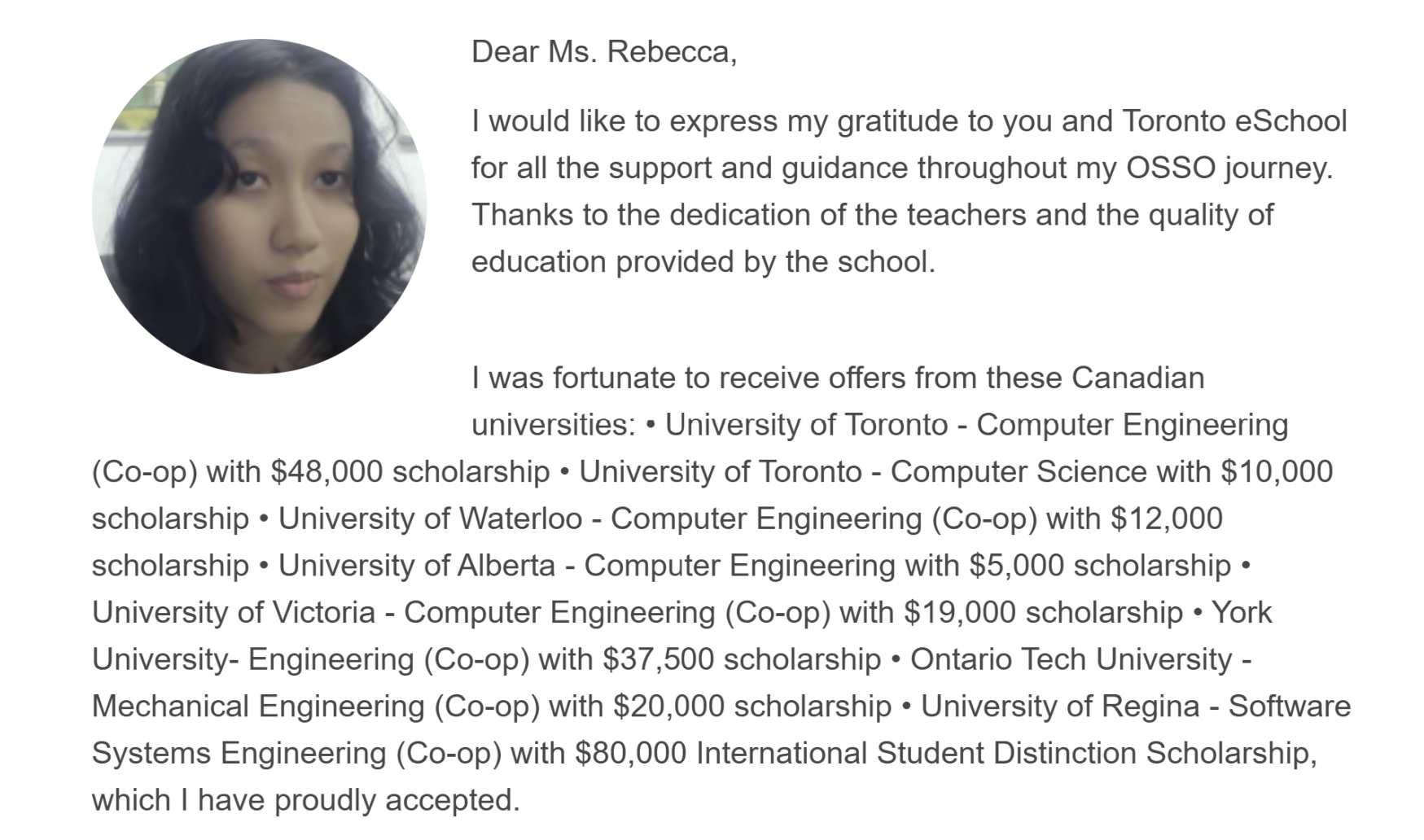
Our students have received university admission offers from leading Canadian universities, including:
- University of Toronto
- University of Waterloo
- McMaster University
- Western University
- Queen’s University
- York University
- University of British Columbia
For example, students featured on our success stories page have shared their experiences of flexible online learning, supportive teachers, personalized academic guidance and successful university applications.
Considering switching from A-Level or IB to OSSD?
Discover how Toronto eLearning School students have achieved their academic and university admission goals.
Read student testimonials, watch graduate videos and explore university admission offers. View Student Success Stories

Toronto eLearning School — Your Canadian Online High School Pathway to University.
 "Hey, Rebecca, Thank you so much for your help. I don't think there is anyone in education who helped me more than you.
I got the final confirmation email and finally got into McMaster thank you for all your help.
I owe my success in university admission to you and Toronto eLearning School."
Hadi Khan, Life Science in McMaster University
 "My name is Kasra Zarbakhsh in Iran. I enjoyed my study at Toronto eLearnihng School with the kind staff. I suggest studying at eLearning School for those International or Canadian students who want to earn the OSSD.
I earned eight credits with eLearning School, got two university offers, and got an OSSD.
Warm regards to Principal & Vice-Principal of Toronto eLearning School, Mr. Bowyer & Ms. Wang."
Kasra Zarbakhsh, Business Administration of Legal Studies in Trent University.
 "Hello miss, I have got my marks. Thank you so much at the end. you helped me a lot with this course. Your feedbacks were very effective to me.
I got many experiences with this. I really appreciate your kindness to refer my mails and reply them all and give feedbacks for my resubmitted assignments as well.
Lucky to have a teacher like you miss. Thank you so much and wish your future works with my best."
Naveen Srimal Kandamulla, Medicine in Manipal Medical University
 I am writing to express my deepest gratitude for your unwavering support and guidance throughout my academic journey with eLearning School.
Your dedication and expertise have been instrumental in my success in the course, and I cannot thank you enough for your invaluable contributions.
Thank you for being an exceptional educator at eLearning School and for making a positive impact on my life. I wish you continued success and fulfillment in your teaching career.
With utmost respect and gratitude, Zaid Hassan
 "Dear Rebecca, Thank you very much for attaching Michael's OSSD and transcript.
Michael has received all his offers from Ryerson University, York University, University of Toronto and Mississauga, U of T.
We would also like to thank you for your wishes. We are very proud of Michael and his accomplishments! Thank you once again."
Anna k., ASSISTANT REGISTRAR, VICTORIA COLLEGE IN THE UNIVERSITY OF TORONTO
 "Dear Rebecca, hope you are doing well.
I am taking this opportunity to thank you so much for the accompaniment, advise and the push done on Williane 's during her studies at Toronto eSchool. It was so benefic to her as now, she fitted very well into the University system... she started with 2 courses and has succeeded with a grade of B+ and A.... she promised to get A+ moving forward... at least, she started with good marks compared the way I was so so much worried about her performance. I have a confident she will be able to finish her studies withing the 4 academic years.
Again, find my sincere gratitude for the journey and support from your side; I will never forget about your advise, push, reminders, mails.... All to get Williane succeed her Grade 12. You are very professional and I m thank God I found a such professional and parent teacher. Remain blessed."
Honorine N., Procurement Manager, United Nations Children's Fund (UNICEF)